Anthropic now ships a design tool, not just a chatbot
- Claude Design launched April 17, 2026, powered by Opus 4.7, Anthropic's most capable vision model.
- It produces prototypes, slides, one-pagers, landing pages, and pitch decks from prompts, images, or existing files.
- A single handoff bundle moves designs into Claude Code for production, closing the loop from idea to shipped product.
- It competes directly with Lovable, v0, and Bolt, but targets non-designers at founders and PMs rather than developers.
- Available now on Pro, Max, Team, and Enterprise plans as a research preview at claude.ai/design.
Anthropic launched Claude Design on April 17, 2026, and it changes what Claude is. The company that built a coding tool for developers now ships a design tool for everyone else. This is Anthropic stepping onto the same ground as Lovable, v0, and Bolt, with a twist that matters for small businesses: the output hands off cleanly to Claude Code for production. For SMBs without a designer on staff, that closed loop is the first serious reason to take an AI design tool seriously.
What is Claude Design and what can it make?
Claude Design is a visual creation product from Anthropic Labs that turns text prompts, image uploads, or existing documents into polished designs, prototypes, slides, one-pagers, and landing pages. It runs on Claude Opus 4.7, described by Anthropic as its most capable vision model to date, and is available at claude.ai/design for Pro, Max, Team, and Enterprise subscribers.
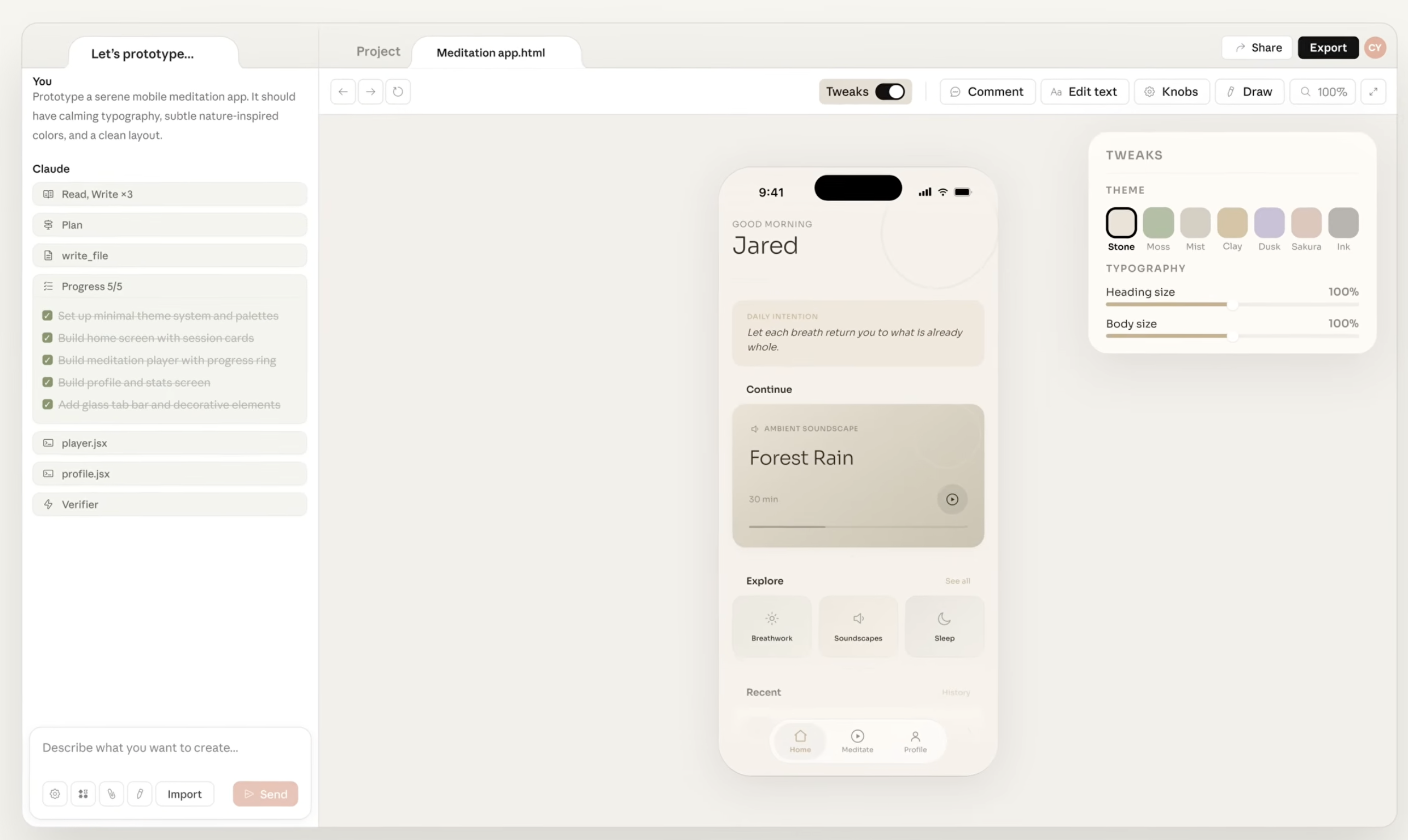
The product is not a chatbot with design templates bolted on. It is a workspace where Claude reads a codebase or design file, extracts the brand system, and applies those colours, typography, and components to every output. That is the core competitive claim. According to Anthropic’s April 2026 launch announcement, teams can maintain multiple design systems in a single account, which matters for agencies or operators running multiple brands.
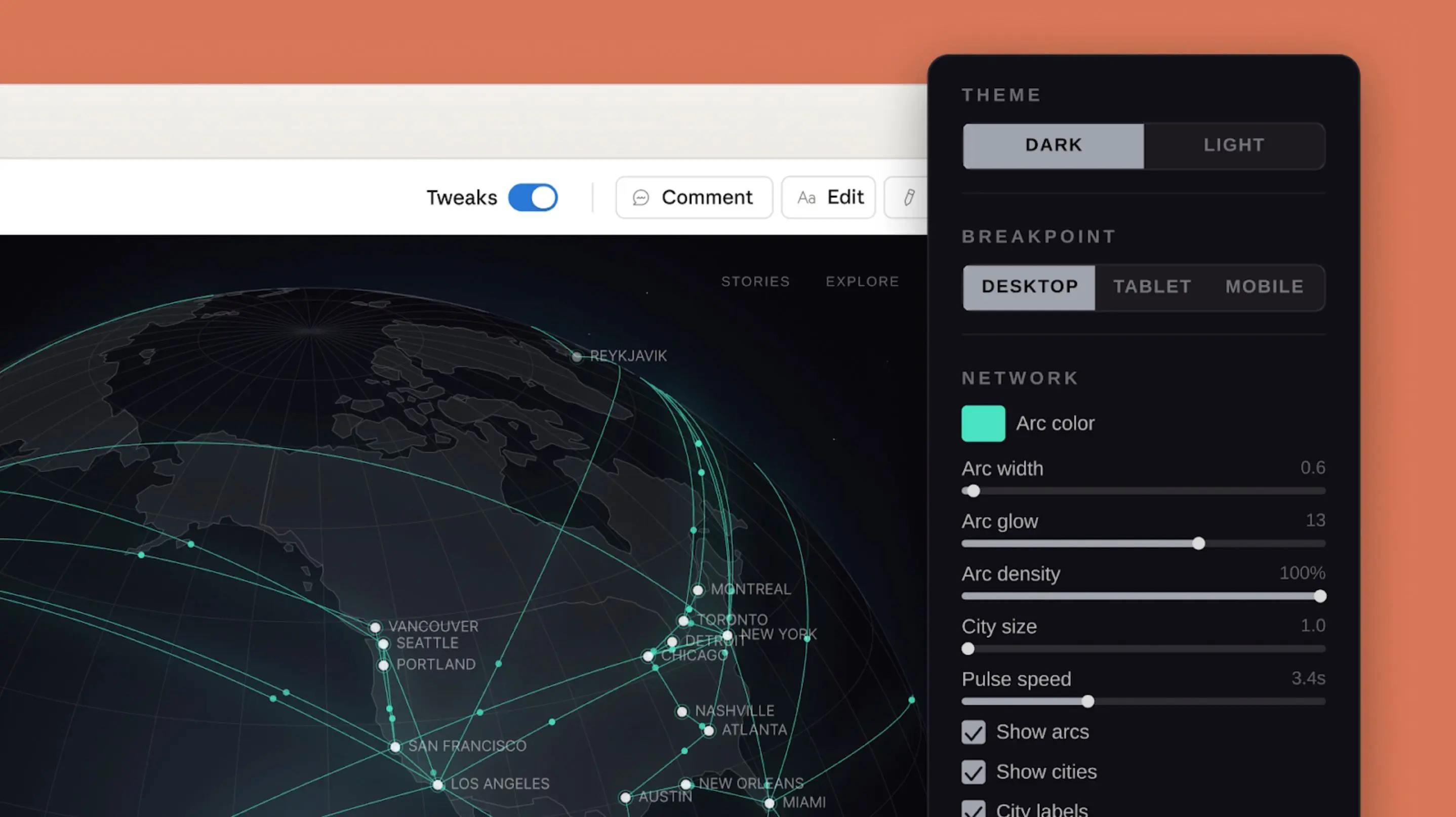
Claude Design accepts prompts, DOCX and PPTX uploads, images, and direct codebase integration, and outputs to Canva, PDF, PPTX, standalone HTML, or shareable URLs. A web capture tool lets users pull elements from any existing site as a starting point. Inline commenting, direct text editing, and adjustment sliders for spacing, colour, and layout make refinement closer to Figma than a chat interface.
What can Claude Design actually build, and how does the workflow work?
The workflow is conversational at the top and visual at the bottom. A founder describes a pitch deck, Claude generates an initial version applying the company’s brand system, and the founder refines with inline comments or sliders rather than re-prompting from scratch. According to Anthropic’s April 2026 launch materials, customer Brilliant saw pages that required 20 or more prompts in other tools now completing in two prompts inside Claude Design.
Typical use cases Anthropic highlights at launch include interactive prototypes for user testing, product wireframes, design direction exploration, pitch decks, landing pages, and code-powered prototypes that incorporate voice, video, shaders, or 3D elements. Datadog’s Aneesh Kethini described the shift in their own quote for the launch: what used to take a week of briefs, mockups, and review rounds now happens in a single conversation.
Collaboration sits inside the tool itself. Multiple users can edit the same project in a group conversation, with organisation-scoped sharing at private, view-only, or editable permission levels. For teams already running Claude Team or Enterprise, Claude Design slots in without adding a new vendor.
How does Claude Design compare to Lovable, v0, and Bolt?
Claude Design competes with Lovable, v0, and Bolt, but targets a different user. Lovable, v0, and Bolt are developer-leaning app builders that produce working applications. Claude Design starts upstream, at the visual layer, and is built for founders, PMs, and marketers who do not start in a design tool and do not need a deployed app on day one.
The practical differences show up in three places:
| Tool | Primary output | Best for | Production handoff |
|---|---|---|---|
| v0 (Vercel) | React components | Front-end developers iterating on UI | Copy-paste into Next.js projects |
| Bolt | Full-stack apps | Fastest end-to-end MVP generation | Deploy from Bolt, or export code |
| Lovable | Collaborative apps | Team development with GitHub branching | GitHub integration, Supabase backend |
| Claude Design | Prototypes, decks, pages | Non-designers producing visual work | Handoff bundle to Claude Code |
The most important competitive difference is the handoff bundle, but it cuts both ways. Claude Design packages a finished design into a single instruction that Claude Code executes as a production build. No other tool in this category hands off to a sibling product with the same level of model alignment. The flip side: Claude Design cannot yet host the output, connect a database, process a payment, or stand up user authentication. Lovable and Bolt can. That gap is the single biggest reason a founder might still reach for a competitor today.
What makes the Claude Code handoff different from competitors?
The handoff bundle creates a closed loop inside one vendor. A PM drafts a feature flow in Claude Design, iterates with the founder inline, and ships the finished design to Claude Code with a single instruction. Claude Code reads the same design system, the same codebase, and the same intent, and writes the production code.
Lovable, v0, and Bolt all generate code directly, which sounds like an advantage but removes a decision point. When the tool that generates the prototype also deploys the production app, the separation between “exploring an idea” and “committing to a build” collapses. Teams end up either over-engineering throwaway prototypes or under-engineering production features. The handoff model forces that gate back into the workflow.
According to Anthropic’s launch announcement, future updates will add integration-building capabilities that connect Claude Design to other team tools. That roadmap suggests the product’s long-term ambition is not to replace Figma, but to become the upstream layer that feeds every downstream surface: slides into Canva, apps into Claude Code, marketing assets into whatever the team already uses.
Who is Claude Design actually built for?
Claude Design is built for the 80% of a company that is not a designer or a developer. Anthropic names the personas explicitly in its launch materials: founders building pitch decks, product managers sketching feature flows, marketers producing landing pages, and executives making one-pagers. These roles drive most SMB software purchasing decisions today.
McKinsey’s 2024 State of AI report found 65% of organisations regularly use generative AI in at least one business function, up from 33% a year earlier, so the adoption curve is already clear. For an Aurora client profile, a five to fifty person company with no designer on staff, this matters for two reasons. First, it removes the “we need to hire a contractor for a deck” friction that kills most in-house marketing experiments. Second, it produces output that a developer, or Claude Code, can actually build from, rather than a slide that gets re-specified from scratch when engineering picks it up.
The Aurora AI Design Readiness Check is three questions every SMB should answer before adopting Claude Design or any competing tool: First, do you already maintain a design system, even a loose one? If not, the tool will invent one, which may not match what you actually want. Second, who is the downstream consumer of the design, a developer, a printer, a client? That dictates the export format that matters. Third, do you have anyone on the team who can give design feedback in words, not gestures? If not, the conversational interface will feel like a black box.
What are the tradeoffs and limitations to know before adopting it?
The biggest limitation is what Claude Design cannot do yet. It has no native hosting, no built-in database, no payment processor integration, and no authentication layer. Lovable ships with an auto-provisioned Supabase backend, one-click publish to production, and chat-driven Stripe setup that generates checkout edge functions and database tables without manual coding. Bolt provisions full-stack infrastructure, authentication, and deployment inside its own environment. Claude Design exports standalone HTML, a Canva file, a PDF, or a handoff bundle for Claude Code. The “prompt to live paid app” path still runs through other vendors.
For a pitch deck, a landing page, or a pre-engineering prototype, none of this matters. For a founder who wants to take a payment from a real customer by end of week, it matters a great deal. The practical workaround today is the Claude Code handoff: design in Claude Design, build in Claude Code, host on Cloudflare Pages or Vercel, and wire Stripe in manually. That is three products and two vendor relationships to cover what Lovable does in one session.
Expect this gap to close fast. Anthropic’s launch announcement promises “integration-building capabilities” in the coming weeks, which reads like the framework for exactly these connectors. A Stripe integration, a Supabase or Neon backend option, and a one-click deploy to a hosted preview URL are the obvious next moves. Anthropic already has the Claude Code handoff as proof that the company can ship tight product-to-product integrations. If the roadmap plays out, Claude Design will match Lovable on backend and deployment inside 2026.
Three smaller limitations matter in the meantime. First, Claude Design is a research preview, and features can ship, break, or get reworked without the usual enterprise support guarantees. Second, usage counts against existing Claude subscription limits, so heavy design work will exhaust the same token pool that a team uses for Claude Projects or Claude Code. Third, enterprise organisations have Claude Design disabled by default. According to Gartner’s 2024 forecast, more than 80% of enterprises will have used generative AI APIs or deployed generative AI-enabled applications by 2026, so most admins have already approved a similar request, but it is still a coordination step.
The deeper tradeoff is vendor concentration. Running Claude Design, Claude Code, Claude Projects, and Claude Cowork on the same account means a single billing relationship, a single policy surface, and a single outage risk. That is usually the right call for a small team that values simplicity, but it is the wrong call for a team that needs independent tool choices at each layer.
How should small businesses approach Claude Design in 2026?
Small businesses should treat Claude Design the way they treated Claude Code at launch: pilot one concrete output, measure the time saved, and expand from there. A good first project is a pitch deck, a landing page, or a prototype for a feature the team has been talking about. The feedback loop is short enough to get a real answer inside one week.
Aurora’s recommendation for most five to fifty person clients is to run the pilot with the person who most often asks “can someone make this look better?” in Slack. That is usually a founder or a PM, not a designer. If Claude Design closes that gap without a contractor, the tool pays for itself inside a single deck. If it does not, the team learns quickly, and the subscription cost is already sunk in the existing Claude plan.
The bigger strategic signal is what the launch tells the market. Anthropic is no longer a coding assistant company. It is building a design-to-deploy stack that competes with Figma, Lovable, v0, Bolt, and Canva at different layers, all routed through one model family. For SMBs, the practical question is no longer whether to use AI for design work. It is which vendor’s stack to bet on, and how deeply to commit.
Frequently asked questions
What is Claude Design? Claude Design is Anthropic’s visual creation tool that turns prompts into prototypes, slides, one-pagers, and landing pages. It launched April 17, 2026 on Pro, Max, Team, and Enterprise plans.
How is Claude Design different from Lovable or v0? Lovable and v0 target developers building apps. Claude Design targets non-designers producing visuals, with a one-click handoff to Claude Code for production builds.
What model powers Claude Design? Claude Opus 4.7, Anthropic’s most capable vision model. The same model that reads codebases and design files to apply a team’s design system to new work.
Can Claude Design export to Figma or Canva? It exports to Canva (via Anthropic’s partnership), PDF, PPTX, standalone HTML, and shareable URLs. Figma export is not yet available at launch.
Is Claude Design free? No. Usage counts against your existing Claude subscription limits. Enterprise admins must enable it in organization settings before their teams can use it.
Who should use Claude Design? Founders making pitch decks, PMs sketching feature flows, marketers building landing pages, and small teams without a dedicated designer. Not a replacement for Figma.
The takeaway for operators is short. Claude Design is the first AI design tool with a credible path from idea to production inside one vendor, and the first that targets non-designers without giving up fidelity. If your team has ever waited a week for a deck or a landing page mockup, this is the experiment to run next.
FAQ
What is Claude Design?
Claude Design is Anthropic's visual creation tool that turns prompts into prototypes, slides, one-pagers, and landing pages. It launched April 17, 2026 on Pro, Max, Team, and Enterprise plans.
How is Claude Design different from Lovable or v0?
Lovable and v0 target developers building apps. Claude Design targets non-designers producing visuals, with a one-click handoff to Claude Code for production builds.
What model powers Claude Design?
Claude Opus 4.7, Anthropic's most capable vision model. The same model that reads codebases and design files to apply a team's design system to new work.
Can Claude Design export to Figma or Canva?
It exports to Canva (via Anthropic's partnership), PDF, PPTX, standalone HTML, and shareable URLs. Figma export is not yet available at launch.
Is Claude Design free?
No. Usage counts against your existing Claude subscription limits. Enterprise admins must enable it in organization settings before their teams can use it.
Who should use Claude Design?
Founders making pitch decks, PMs sketching feature flows, marketers building landing pages, and small teams without a dedicated designer. Not a replacement for Figma.